
Guapote on Lake Arenal
How, when and where to catch rainbow bass
Lake Arenal's guapote bite all year, but the dry months from about January to May are usually best, because the hydro reservoir drops and the fish crowd onto the remaining cover. Book a half day with a guide from El Castillo or Nuevo Arenal, start at first light, and expect 1 to 5-pound fish on topwater, spinnerbaits and crankbaits, with the odd 10-pounder.
At a glance
- Main fish
- Guapote (Parachromis dovii), sold as rainbow bass; also jaguar guapote, machaca and tilapia
- Typical size
- 1 to 5 pounds; Arenal has produced fish of 10 to 12.5 pounds
- Best months
- All year; drier months, about January to May, as the lake drops
- Best time of day
- First light along the shallow edges, then deeper water as the sun climbs
- Boats leave from
- El Castillo dock (volcano side) and the Nuevo Arenal ramp (north shore)
- Lake level
- Run by ICE for hydropower; it has swung between about 529 and 546 metres above sea level
- Licence
- Guides on our list include the fishing licence in the trip
Part of our complete guide: Freshwater fishing in Costa Rica: the complete guide
Lake Arenal is where most visitors catch their first guapote, the hard-hitting Central American cichlid that guides sell as rainbow bass. The short version: go with a guide, be on the water at first light, and if you can choose, come in the drier months from about January to May, when the reservoir drops and the fish have fewer places to hide.
This guide goes deeper than the Arenal section of our complete guide to freshwater fishing in Costa Rica: how the lake's rising and falling water changes the fishing, which parts of the lake the guides work, the lures that catch fish, and what to ask before you book. If you're also heading north to the tarpon lagoons, read our companion piece on Caño Negro and the Río Frío.
What a guapote is, and what else bites
The guapote (Parachromis dovii) is the biggest cichlid in the region. FishBase lists a maximum of 72 centimetres and 6.8 kilograms, and it lives naturally on both slopes of Honduras, Nicaragua and Costa Rica. Adults eat mostly other fish, which explains everything about how you catch them: they ambush from cover and smash anything that looks like a fleeing baitfish. They aren't related to North American bass, but they hide in timber and weed like one and often jump when hooked.
On Arenal most fish run 1 to 5 pounds, according to a 2025 trip report from Two Weeks in Costa Rica. Bigger ones are there. The Tico Times reported a 10-pound 6-ounce guapote trolled deep off Snake Island in 2005, and a 12.5-pounder trolled along the southwest shore in 2006. The paper added that an Arenal fish of that same weight once held the International Game Fish Association world record for the species, later beaten by a fish from Nicaragua.
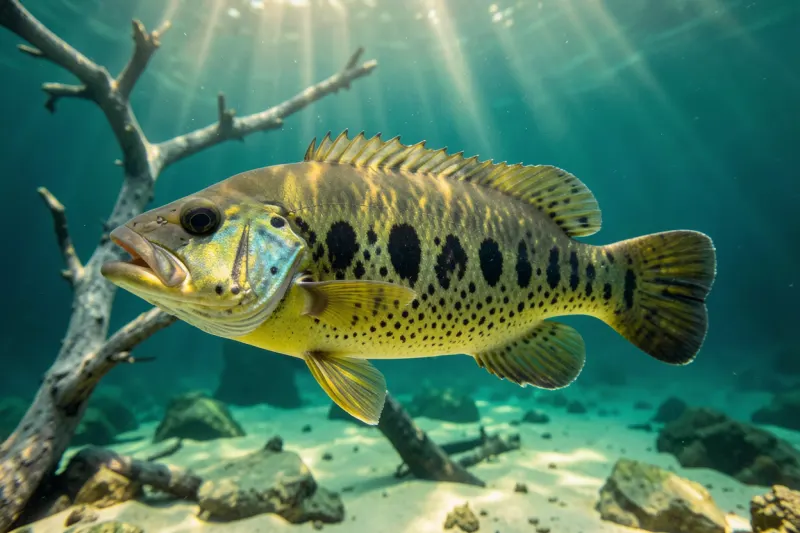
Your guide may also put you on:
- Jaguar guapote. A smaller cousin with a bold blotched pattern and sharp teeth; FishingBooker lists a typical size of 1 to 2 pounds. Arenal guides catch it on the same lures.
- Machaca. A lean, silver, big-scaled fish that jumps like a small tarpon. It's mostly a fruit and insect eater but hits small lures, and it tires fast, so release it quickly and keep it wet.
- Tilapia. Not native. The 2025 report says the lake's tilapia most likely escaped from a fish farm near Tronadora, and some top 5 pounds.
- Mojarra. A small panfish that fights hard for its size.
How the lake works: a reservoir that rises and falls
Arenal isn't a natural lake in the usual sense. The Sangregado Dam, finished in 1979 at the southeastern end, roughly tripled an older, smaller lake, and the old towns of Arenal and Tronadora went under the water. The flooding left drowned forest, old fence lines and submerged roads, and that's the structure guapote live in. In low years, the 2025 report says, you can see the old fences poke out of the water.
The lake is about 85 square kilometres and 30 kilometres long, and it's the main reservoir of the national power grid, run by ICE, the state electricity company. ICE fills it during the rains and draws it down to keep the lights on through the dry season. In January 2025, after a very wet year, El Observador reported the water at 546.87 metres above sea level, its highest in 20 years, with only the crowns of the shoreline trees showing near El Castillo; ICE said at the time that the level moves between about 529 and 546 metres. Two years earlier the paper reported the lake at 532.83 metres at the end of May 2023, having dropped steadily since early December.
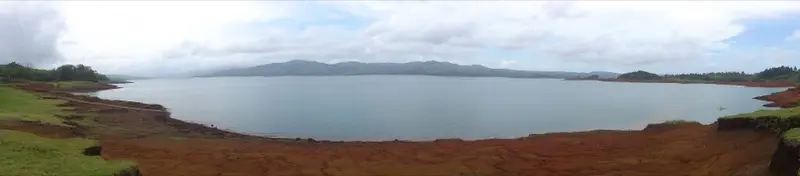
That swing of up to 17 metres is the single most useful thing to understand about Arenal fishing:
Low waterlate dry season
The shoreline pulls back from the trees and weed beds, and the fish pack into whatever cover is left. Anglers and travel guides agree fishing is usually better then. A 2007 Tico Times report, written when the lake was very low, described fish forced out of their usual cover and several rainbow bass of 8 to 10 pounds.
High waterlate rainy season
Fish spread out into flooded brush and timber far from open water. They're still there, but harder to find, and guides lean more on trolling and on drop-offs.
A 1986 study by J. A. Campos in the Revista de Biología Tropical found that guapote occupied the whole lake, favouring bays with plant cover and areas full of fallen trunks. A later study notes that on Arenal the species prefers rocky areas with moderate current. In practice that means weedy bays, rocky points and drowned timber, at whatever depth the lake level puts them.
Month by month
There's no closed season for guapote on Arenal that we could find, and guides fish it all year. This is what to expect.
| Months | Lake and weather | Fishing |
|---|---|---|
| January to April | Dry season; lake dropping; steady winds on the west end | Fish concentrating on remaining cover; usually the best stretch |
| May | Rains begin; lake near its lowest | Still good while the water stays low; calm mornings |
| June to August | Afternoon storms; lake starting to rise | Fish spread out; early starts matter most |
| September to December | Wettest months; lake high, often flooding shoreline brush | Fish deep in flooded cover; trolling and jigging come into play |
Wind matters too. From about November to April, strong, reliable winds blow over the western end, which is why that half of the lake is a windsurfing and kitesurfing spot. Guides tuck into the sheltered arms when it's blowing, and mornings are almost always calmer than afternoons.
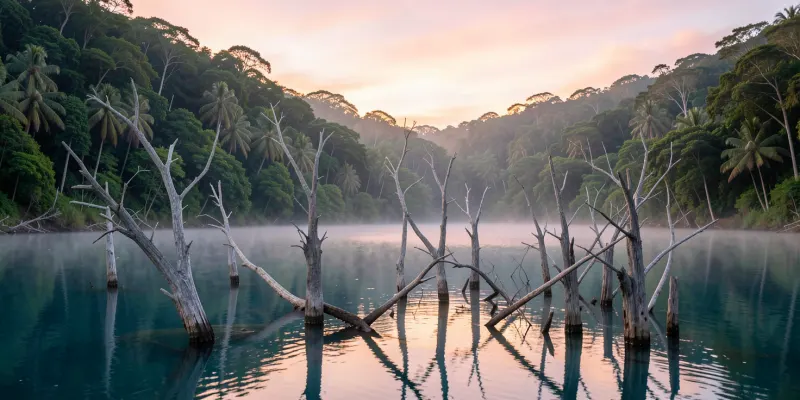
Where on the lake the guides fish
Guides don't publish their spots, but the lake divides into a few clear zones.
| Area | What it's like | Notes |
|---|---|---|
| El Castillo and the volcano end | Closest to La Fortuna; bays and points below Arenal Volcano | El Castillo guides launch from the village fishing dock |
| Near the dam | The road access closest to La Fortuna | Some guides pick up here |
| North shore, Nuevo Arenal | Coves, points and islands; the municipal ramp | About an hour's drive from La Fortuna; where many charters start |
| Southwest shore | Deep water along the shoreline | Where the 12.5-pound fish was trolled in 2006 |
| Snake Island | A small island in the lake | Where the 10-pound fish was trolled in 2005 |
| Western end, toward Tilarán | Open and windy from about November to April | Better on calm mornings |
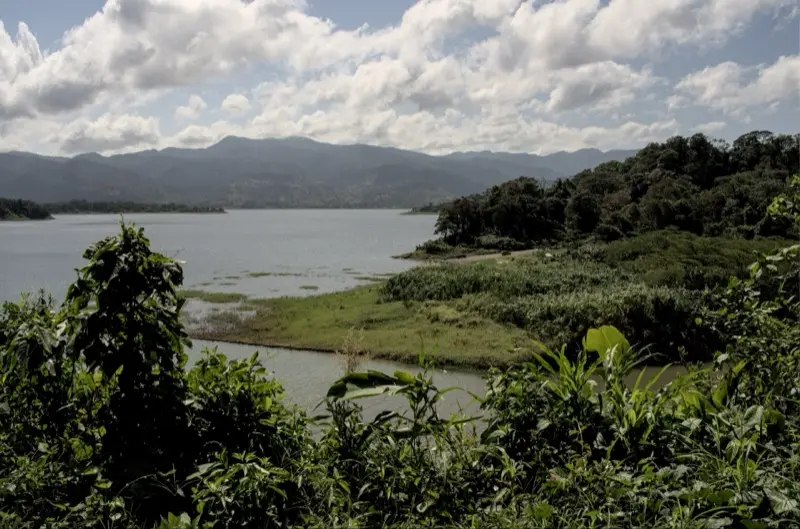
How to catch them: lures, methods and gear
Guides supply all the tackle, but it helps to know the game plan. A typical morning on Arenal goes in this order.
First light: topwater and spinnerbaits
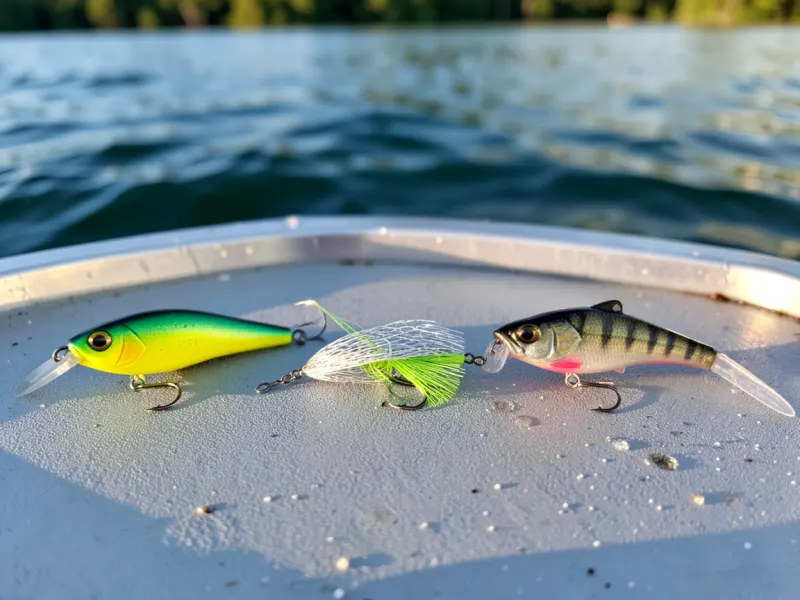
At dawn guapote hunt the shallow edges. Guides cast topwater plugs (poppers, walking baits, a jitterbug-style lure) tight to partly flooded tree lines and old fences, and run spinnerbaits right along the bank. A quiet electric trolling motor lets the boat slide along grassy shorelines without spooking the fish; both El Castillo boats below carry one. This is the most exciting part of the day, because you see the strike.
Mid-morning on: crankbaits, trolling and jigging
As the sun climbs, the fish drop deeper. Guides switch to deep-diving crankbaits along drop-offs, troll Rapala-style minnows at medium speed around islands and points (the method behind both big Tico Times fish), or jig vertically over structure. Both El Castillo guides list jigging among their methods (Salomón lists trolling too), and on a slow day expect yours to switch between them until something works. Some guides also fish live baitfish.
Fly fishing
Guapote will take streamers and poppers along weed lines and timber. A 7 or 8-weight rod with a floating line and a sinking-tip spare covers it. Osprey Fishing Tours lists fly gear as included; with other guides, ask, or bring your own.
What to bring
- Polarised sunglasses, a hat and a light rain jacket, even in the dry season.
- Your own favourite lures if you like, but ask first: guides know what's working this week.
- Pliers and a bit of patience: jaguar guapote have sharp teeth, and a guapote's mouth is tough.
Booking a guide
Most trips run as a half day of 4 or 5 hours (often a 6 or 7 a.m. start, or an afternoon trip) or a full day of about 8 hours. Boats are trailered or kept at small docks rather than waiting at a marina, so book ahead. Ask whether hotel pickup is included; on the two El Castillo listings below it isn't, though it can be arranged.
We chose these on evidence we could check this month: a working booking page, recent dated reviews or reports, and boat and gear details. Nobody pays to be listed.
Arenal Lake Fishing with SalomónEl Castillo
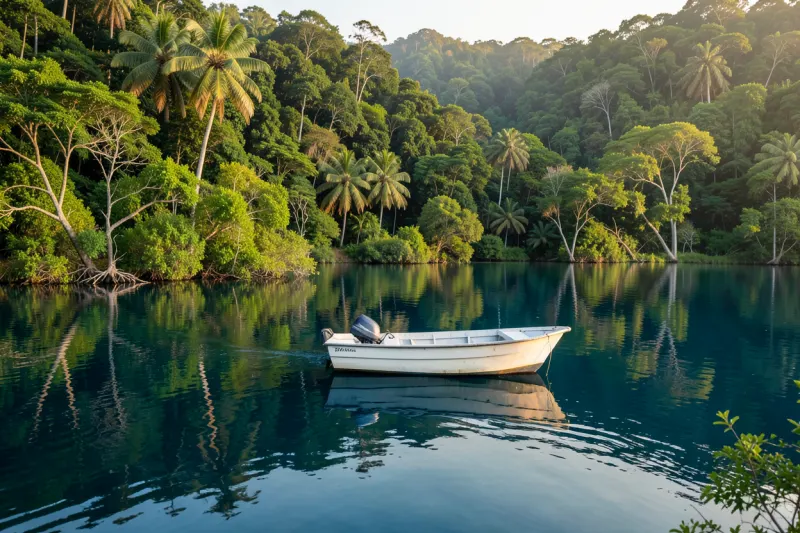
Captain Gohering Salomón Rodríguez fishes guapote, machaca, tilapia and mojarra from a 2025 16-foot Lowe aluminium boat with a 40-horsepower Mercury, a fishfinder and a wireless trolling motor, for up to 3 people. Morning and afternoon trips of 4 hours; the licence, rods and lures are included. His FishingBooker page shows 29 reviews, the newest for a trip on 2026-Oct-04; a July 2026 review mentions machaca and rainbow bass.
Osprey Fishing ToursEl Castillo
Captain Bryan Rodríguez runs an 18-foot ProCraft bass boat, restored in 2022, with a 140-horsepower Suzuki and a 105-pound-thrust trolling motor, from the El Castillo fishing dock, for up to 4 people. Half days of 5 hours and full days of 8; licence, tackle, fly gear and a first mate included. His FishingBooker page has a review for a full day on 2026-Oct-02 and a trip report dated 2026-Nov-01.
Desafío Adventure CompanyLa Fortuna
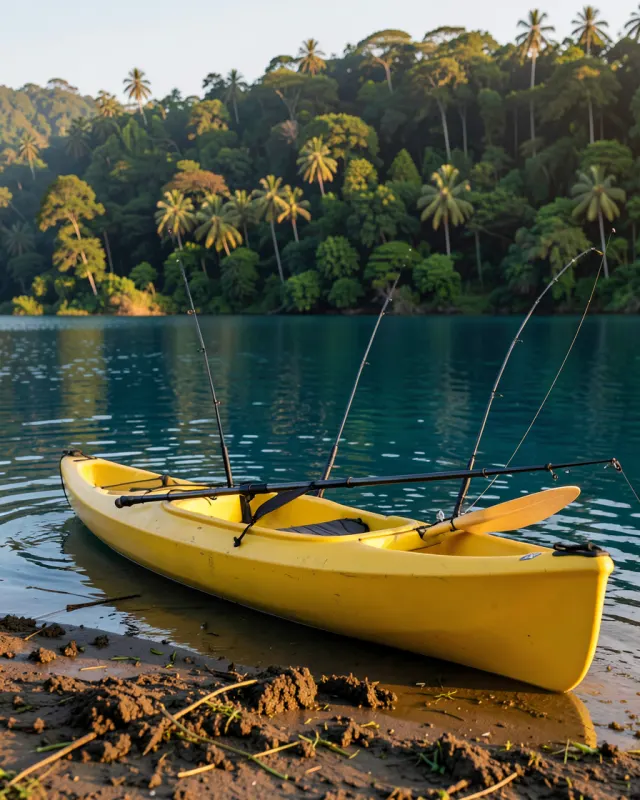
If you'd rather paddle, this long-running La Fortuna adventure company runs a 4-hour kayak fishing trip in the calm bays at the volcano end, early in the morning, for machaca and guapote. Transport, a guide, fishing kayaks, safety gear, rods, poppers and tackle are included; ages 15 to 85, minimum 2 people.
Questions worth asking any Arenal guide:
- Which licence is included, and do I need to bring my passport?
- Where do we launch, and how long is the drive from my hotel?
- What's the plan if the west end is blowing?
- Do you release the bigger guapote? (The ones on our list allow release; ask before you assume you're keeping fish.)
Keep the big ones swimming
Guapote grow slowly and live a long time. A study of the species in another Costa Rican lake, Hule, estimated a life cycle of 8 to 10 years and recommended limits on fishing effort and a closed season during spawning. On Arenal itself, Campos warned as far back as 1986 that the guapote stock was being overfished, with no rules in place, and he suggested the fish probably spawn around August or September. We found no closed season or bag limit for Arenal today, so the stock depends on anglers.
FECOP, the national sport fishing federation, asks freshwater anglers to keep fish in the water, handle them with wet hands, never hold them by the gills, flatten barbs where possible and never move live fish or bait between waters. On Arenal that means a quick photo of the big fish and back it goes. If you want to eat a guapote, keep a small one and ask your guide; it's good eating.
One safety note: crocodiles and caimans live in the lake, so don't wade or swim off the bank where your guide wouldn't.
The Festival del Guapote
El Castillo's tourism chamber runs a catch-and-release guapote tournament at the Paradero Lacustre El Castillo, below the volcano. The May 2025 edition ran from 23 to 25 May; the prize went to the longest fish, not the heaviest, and the species allowed were guapote pinto, azulón, jaguar and machaca. The organisers said it had been running for 2 years, and that year's money went toward a bridge over the local Caño Negro river near El Castillo (a different place from the Caño Negro refuge in the far north). We couldn't find a 2026 date, so check with the chamber before planning around it.
Getting there and making a day of it
La Fortuna is about 2.5 hours by road from San José and about 3.25 hours from Liberia, according to EnterCostaRica's drive-time chart. El Castillo is a short drive beyond La Fortuna on the volcano side of the lake, and Nuevo Arenal is about another hour around the north shore. A morning trip fits neatly before the hot springs, or before an afternoon drive north toward Caño Negro.
Arenal is just one part of the freshwater picture. For the trout streams, the machaca rivers and the rules on inland waters, go back to our complete freshwater fishing guide, and for tarpon and gar in the northern lagoons see Caño Negro and the Río Frío. If you're flying in and out of San José with a spare day, our guide to fishing near San José covers the closest options.
Frequently asked questions
What is the best month to fish for guapote on Lake Arenal?
They're caught all year, but the drier months from about January to May are usually best, because the reservoir drops and the fish crowd onto the remaining cover. Mornings beat afternoons in every month.
How big do Lake Arenal guapote get?
Most are 1 to 5 pounds. The lake has produced fish of 10 to 12.5 pounds, and an Arenal guapote once held the IGFA world record for the species.
Do I need a fishing licence on Lake Arenal?
Both El Castillo guides on our list include the licence in the trip. If you fish with someone else, ask who arranges it, and carry your passport.
Can I fish Lake Arenal from shore?
In places, yes, but most banks are private land and the best fish hold on cover you can only reach by boat. A guided boat or kayak trip is far more productive.
Is a half day enough?
For most people, yes. The first 3 hours after dawn are the best of the day. Take a full day if you want to fly fish, troll for a big fish or explore the far end of the lake.
Sources
- Fishing on Lake Arenal (Two Weeks in Costa Rica, updated August 2025)
- Lake Arenal (Wikipedia)
- Monster guapote taken at Arenal (The Tico Times, December 2006)
- First-timer scores big guapote (The Tico Times, September 2005)
- Red tide on Pacific, water low at Arenal (The Tico Times, May 2007)
- Agua del embalse del Lago Arenal tapa los troncos de los árboles y alcanza su nivel más alto en 20 años (El Observador, January 2025)
- Pierde nivel embalse del Arenal (El Observador, May 2023)
- El recurso pesquero de guapote (Cichlasoma dovii) en el embalse de Arenal (J. A. Campos, Revista de Biología Tropical 34, 1986)
- A management plan for the sport fishery of Parachromis dovii in Hule lake, Costa Rica (Tabash and Guadamuz, Revista de Biología Tropical 48, 2000)
- Parachromis dovii, guapote (FishBase)
- Arenal Lake Fishing with Salomón (FishingBooker)
- Osprey Fishing Tours (FishingBooker)
- Jaguar guapote fishing (FishingBooker)
- Kayak fishing at Arenal Lake (Desafío Adventure Company)
- Festival del Guapote se celebrará este fin de semana en El Castillo (Delfino.cr, May 2025)
- Buenas prácticas en la pesca deportiva en aguas continentales y estuarios (FECOP, 2024)
- Drive times in Costa Rica (EnterCostaRica)


