
Pacific cubera snapper (pargo dientón) in Costa Rica
The Pacific cubera snapper, pargo dientón to Costa Rican crews, is the biggest snapper on the Pacific coast and lives on rocky reefs from Guanacaste to the Osa all year. It's caught on poppers at dawn, live bait near the rocks and jigs, and while it isn't protected, most crews release the big breeding fish. Costa Rica held its all-tackle world record from 1988 until a Mexican fish beat it in 2026.
At a glance
- Names
- pargo dientón or pargo negro; Pacific dog snapper; Lutjanus novemfasciatus
- Range
- eastern Pacific only (Mexico to Peru); not on the Caribbean, which has a different cubera
- Size
- up to 170 cm; heaviest records about 36 to 45 kg; first breeds at about 70 cm
- Where
- Pacific rocky reefs, points and islands, 2 to 60 m; young fish in mangroves and river mouths
- Best months
- all year; Crocodile Bay calls April the month for record-size fish in the south
- Rules
- not protected; counts in the 5-fish limit; most crews release big fish
- Record
- 78 lb 12 oz, Bahía Pez Vela, Costa Rica, 1988, beaten by an 84 lb 5 oz Mexican fish in 2026 (IGFA)
Part of our complete guide: Costa Rica Fish Species: The Complete Guide
The short answer
The Pacific cubera snapper is the heavyweight of Costa Rica's inshore fishing: a thick, copper-and-olive snapper with dog-like fangs that lives on the rocky reefs of the Pacific coast all year and can top 35 kg. Crews call it pargo dientón ("the toothy snapper"). It hits poppers and live bait close to the rocks, then dives straight back into them, which is why anglers come back for it. It isn't protected, but most good crews let the big ones go.
This article goes deeper on this one fish: its names, how to be sure you've got one, where and when each coast fishes best, how local crews catch it, what to keep and the records. For every snapper on both coasts, see our snapper family page, and for every other species, our complete guide to Costa Rica's fish.
Names: dientón, negro, dog or cubera
The fish is Lutjanus novemfasciatus, and the Latin means "nine-banded", after the bars on young fish. In English it's the Pacific dog snapper or Pacific cubera snapper. On a Costa Rican boat you'll hear pargo dientón most, and also pargo negro. The FAO's snapper catalogue lists pargo negro and pargo jilguero as its Costa Rican market names.
Two cautions. First, "pargo prieto" is used for several dark snappers on both coasts, so don't trust it alone. Second, the Caribbean cubera (Lutjanus cyanopterus) is a different species from the other ocean. Costa Rica has both, but never in the same water: the Pacific cubera lives only in the eastern Pacific, from Mexico to northern Peru.
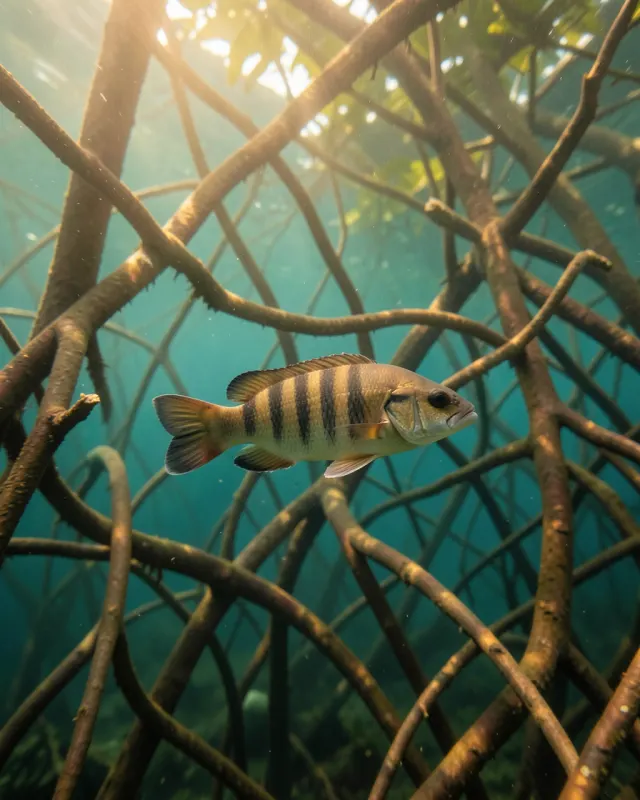
The cubera starts life in brackish water. FishBase says young fish live in mangrove estuaries and river mouths, and MarViva notes that adults can swim up to 20 km up rivers. Adults move out to rocky reefs, from 2 to about 60 m deep, usually 5 to 12 m according to FishBase. MarViva lists it as Least Concern on the IUCN Red List, and its diet as octopus, squid, crabs, shrimp and fish.
How to tell a Pacific cubera from other snappers
A big dark snapper hauled up from the rocks isn't always a cubera. These are the fish it gets mixed up with on the Pacific side:
| Fish | Spanish | Colour | Look for | Size |
|---|---|---|---|---|
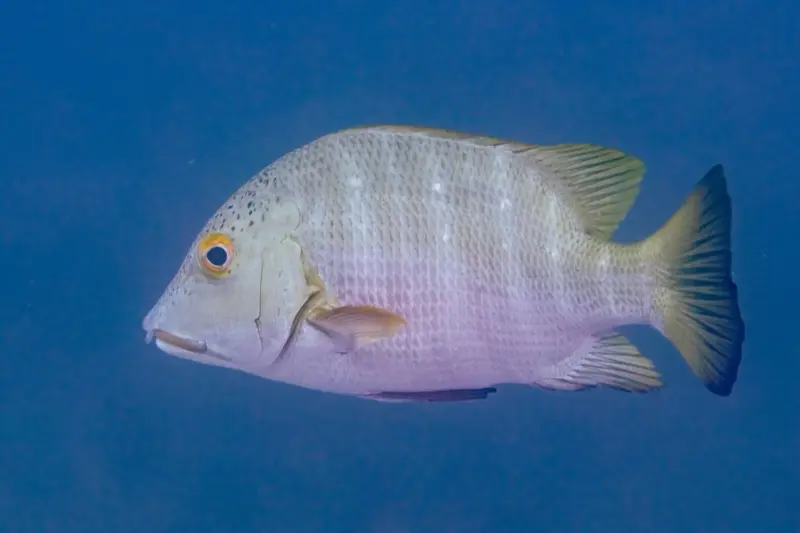
| Pacific cubera (dog) snapper | pargo dientón, pargo negro | Dark olive-brown to copper-red, silver-white belly | Big canine fangs at the front of both jaws; grey bars on young fish; inside of the mouth reddish-yellow | To 170 cm |
| Colorado snapper | pargo colorado | Mainly red | Same 10 dorsal spines, but a brighter, redder fish | Smaller |
| Mexican barred snapper | pargo coconaco | Greenish-brown back, pinkish belly | About 8 bluish-brown bars and a long tube-shaped front nostril | To 92 cm |
| Mullet snapper | pargo roquero, raicero | Grey-green to red | Light and dark stripes running along the sides; 11 or 12 dorsal spines | Smaller |
| Yellow snapper | pargo amarillo | Rosy to golden | Bright yellow fins and tail | To 71 cm |
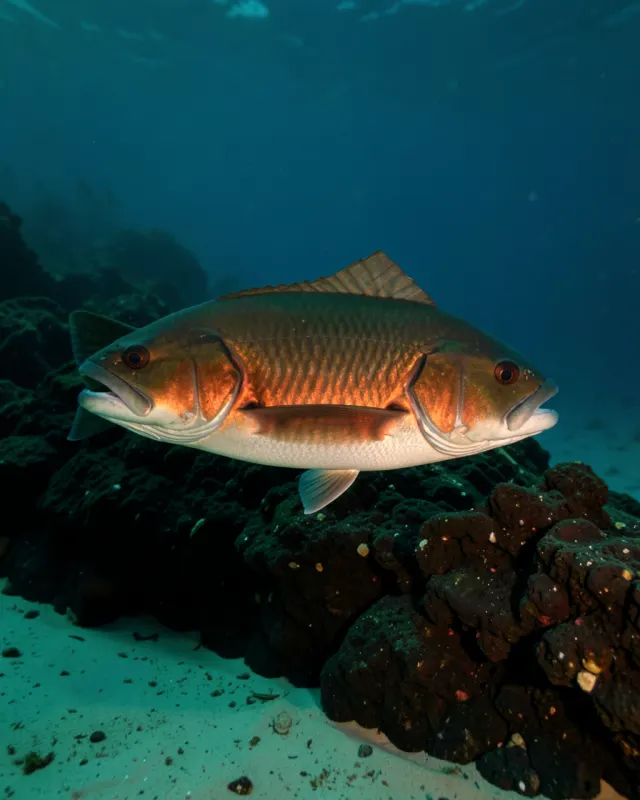
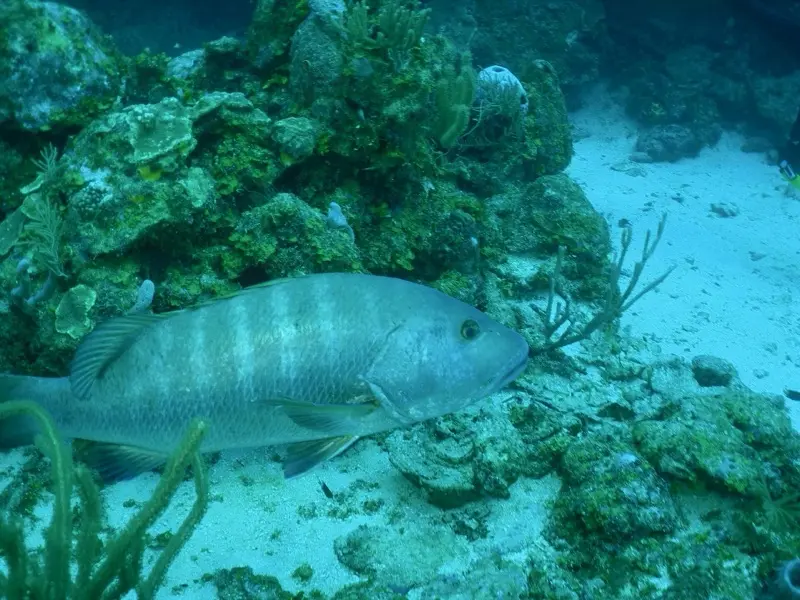
The FAO's description of the cubera is the one to remember: a rounded snout, a squared-off tail, 10 spines in the dorsal fin, and a dark body that can look olive, coppery or almost purple. Young fish have 9 dark bars and black edges on the dorsal and anal fins, and big adults sometimes keep faint bars. The teeth settle it: no other Pacific snapper has fangs like a cubera's.
How big they get
FishBase lists a maximum of 170 cm and a heaviest published weight of 35.7 kg, and MarViva gives 45 kg. MarViva also puts first breeding at about 70 cm total length, which is the most useful number in this article: anything shorter hasn't spawned yet.
Most cubera caught on sport trips here are well short of the giants. Crocodile Bay reports fish over 50 lb in the Golfo Dulce area all year, and Todd Staley, writing for The Tico Times, described his last trip's best fish as 38 lb. The really big ones are seen more often than landed: Staley wrote in 2020 of a fish he put at 90 to 100 lb following his lure in about 25 feet of water.
Where and when, coast by coast
Cubera are caught all year. FishingBooker's monthly table rates snapper fishing strong in every month except October, and calm, clear water near the rocks matters more than the calendar.
| Zone | Where to look | When it's best | Notes |
|---|---|---|---|
| Guanacaste | Rocky points, islands and reefs from Papagayo south to Tamarindo | All year; calmer outside the December to March winds | Home of the 1988 world record (Bahía Pez Vela) |
| Nicoya Peninsula | Rocky points off the southern tip, fished from beach pangas | All year | No fishing inside the Cabo Blanco reserve itself |
| Central Pacific | Rocky points and islands off Jacó, Esterillos and Quepos | All year | An Esterillos-based angler reported a 100-lb-plus fish in 2022 |
| Southern Pacific | Golfo Dulce, Cabo Matapalo, Drake Bay | All year; Crocodile Bay calls April outstanding, May abundant | Isla del Caño is closed to fishing |
| Caribbean | None | The Caribbean has the Caribbean cubera instead |
Guanacaste
The north's rocky coast and offshore islands are classic cubera ground, and the 1988 world-record fish came from Bahía Pez Vela, near Playa Ocotal. The catch: from December to March the Papagayo winds can blow the outer rocks out of reach, so crews fish sheltered bays on those days. The rocks where crews slow-troll for roosterfish in Guanacaste hold cubera too.
Nicoya and the Central Pacific
On the southern Nicoya Peninsula, the beach pangas list cubera among their inshore catches (more in our panga fishing guide). On the Central Pacific, the rocky points and islands between Jacó and Quepos produce fish, and in 2022 an angler who spends part of each year at Esterillos reported a cubera of over 100 lb from this coast. It was never weighed on a certified scale, so it stays a story, but it shows what lives there.
Southern Pacific
The far south is the best-known cubera coast. The Golfo Dulce's deep, calm water and the reefs off Cabo Matapalo hold big fish close to the forest, and the gulf's mangroves and rivers are the nursery that feeds them. Crocodile Bay in Puerto Jiménez calls April outstanding for record-size cubera and May abundant, and the Zancudo Lodge and the boats of Puerto Jiménez fish the same waters. Our Golfo Dulce guide covers the grounds in detail.
How crews catch them
Poppers at first light
Throwing a big popper or stickbait tight to the rocks at dawn is the most exciting way to meet a cubera. Staley wrote that snapper will rise from 100 feet of water "to take a popper", and the hit is violent. Modern high-speed reels and braided line let anglers do this on much lighter gear than the old 80-lb outfits. Our guide to popping and jigging covers rods, lures and technique.
Live bait near the rocks
The most reliable way to catch the biggest fish is a live bait slow-trolled or drifted along the reef. Staley describes the old way, a live bonito caught that morning, and modern baits of 3 to 5 lb; blue runners and goggle-eyes are favourites. Timing is everything, he explains: the fish needs time to eat the bait, but not enough to reach its cave before the hook is set.
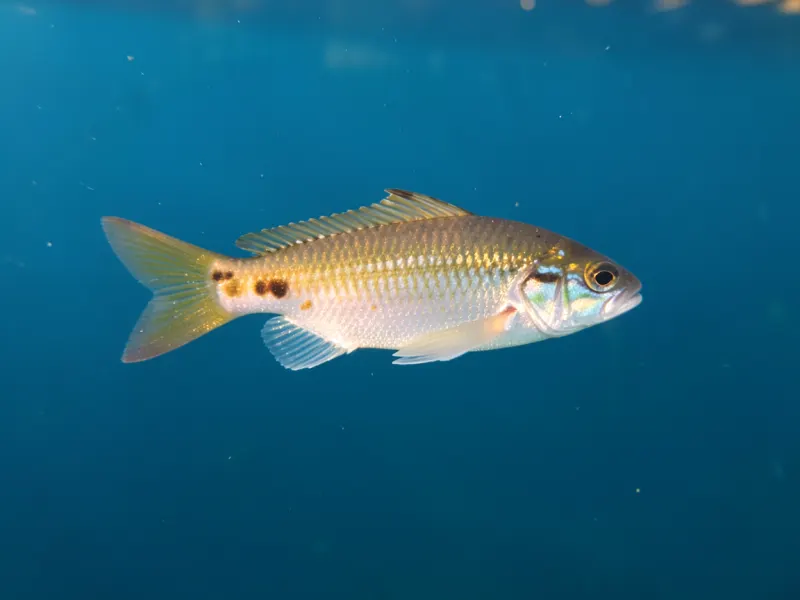
Jigging
Speed jigs and slow-pitch jigs dropped over deeper rock take cubera along with grouper and other snappers. It's the method for days when nothing shows on top.
The fight
A cubera's first run goes straight for the rocks, and many are lost in the first few seconds. Crews fish heavy braid and a long, heavy leader, set the drag tight and steer the boat away from the reef the moment a fish eats. Watch your hands when it comes aboard: those fangs give the fish its name.
Keep or release?
The Pacific cubera isn't a protected species in Costa Rica. Under the fisheries regulation (Decreto 36782), sport anglers can land 5 fish per trip for their own use, and selling a sport catch is banned. INCOPESCA's legal first-capture sizes (AJDIP/026-2018) cover several commercial snappers but we found no figure for the cubera.
So the sensible rule comes from the biology. A cubera under about 70 cm hasn't bred yet, and the giants are mostly old breeding females. Crocodile Bay says its crews generally release the larger fish for that reason. Staley thinks cubera may be making a comeback, helped by the end of shrimp trawling (which caught huge numbers of young bottom fish) and by more captains releasing big fish, though he says it's too early to prove. Our conservation guide explains how releases work.
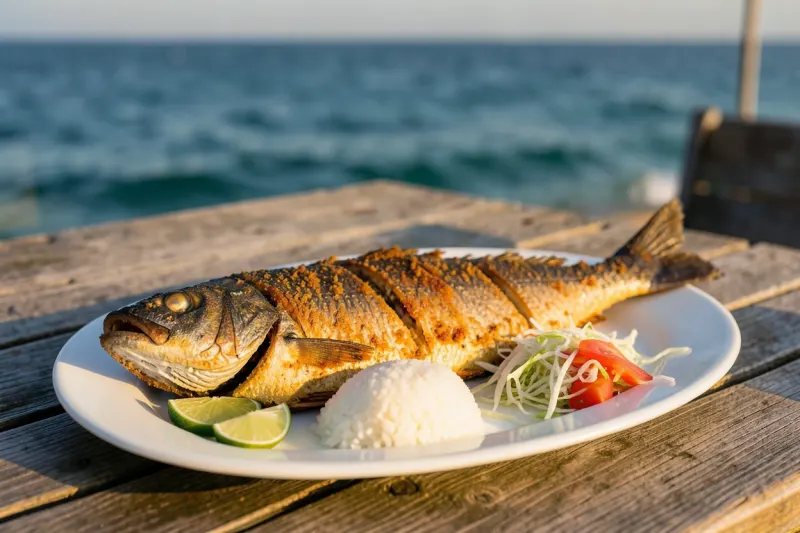
If you keep one, a cubera of a few kilos is good eating, white and firm, and Costa Rican kitchens fry snapper whole. Choose a mid-sized fish over a giant: the big ones are the breeding stock, and the meat of a smaller fish is better anyway.
Records
1988 to 2026
Costa Rica held the IGFA all-tackle world record for 37 years with a fish of 78 lb 12 oz, caught by Steven Paull at Bahía Pez Vela in Guanacaste. It was also the men's 30-lb line-class record.
2026
the IGFA's April 2026 list of approved records shows a new all-tackle record of 38.24 kg (84 lb 5 oz), caught by Robert J. Critser at El Morro Island, Jalisco, Mexico, on January 2, 2026.
The ones that got away
a released fish of about 75 lb near Piñas Bay, Panama, in December 2022, and the uncertified 100-lb-plus Costa Rican fish reported by an Esterillos-based angler, written up the same month.
Frequently asked questions
Is the Pacific cubera the same as the cubera in Florida and the Caribbean?
No. The Caribbean and Florida cubera is Lutjanus cyanopterus, an Atlantic fish. The Pacific cubera (pargo dientón) is Lutjanus novemfasciatus, found only in the eastern Pacific. They look alike and fight alike.
When is the best time to catch a cubera in Costa Rica?
They're caught all year. In the south, Crocodile Bay calls April the month for record-size fish. Calm, clear days and the first hour of light near the rocks matter more than the month.
Can I keep a cubera snapper?
Yes. It isn't protected, and it counts toward the 5-fish-per-trip limit. Most crews keep a mid-sized fish and release the big breeders, and anything under about 70 cm hasn't spawned yet.
What's the best bait for big cubera?
A live bonito, blue runner or goggle-eye fished close to the reef. Poppers catch plenty, and they're more fun, but live bait accounts for many of the biggest fish.
Do I need a licence?
Yes. Everyone fishing from a boat needs an INCOPESCA sport fishing licence, and many charters arrange it. See how to get a Costa Rica fishing licence.
Charters and places in this guide

Puerto Jiménez · fishing lodgeCrocodile Bay ResortCrocodile Bay is a sportfishing operation and marina in Puerto Jiménez, on the Osa Peninsula side of the Golfo Dulce, running…
Playa Zancudo · fishing lodgeThe Zancudo LodgeThe Zancudo Lodge is a fishing lodge on Playa Zancudo, near the mouth of the Golfo Dulce in Costa Rica's far south. Its fleet of…
Southern PacificPuerto Jiménez: sportfishing on the Golfo Dulce and the Osa coastPuerto Jiménez is the main town on the Osa Peninsula, on the shore of the Golfo Dulce, and a base for both calm-water inshore…Sources
- Best practices guide for tourist and sport fishing in Costa Rica, Pacific dog snapper profile (MarViva, 2023)
- Lutjanus novemfasciatus species summary (FishBase)
- FAO species catalogue, snappers of the world: Lutjanus novemfasciatus (Allen, FAO, 1985)
- FAO species catalogue, key to eastern Pacific Lutjanus (Allen, FAO, 1985)
- Hoplopagrus guentherii species summary (FishBase)
- IGFA world records, recently approved, April 2026 (International Game Fish Association)
- Fish facts: what is the world's biggest snapper? (Saltwater Sportsman)
- Likely world record over 100-pound Pacific cubera caught but not officially recorded (Bob McNally, Sport Fishing, December 2022)
- Near-record 75-pound cubera snapper caught and released (Sport Fishing, December 2022)
- On the water with FECOP: are cubera snapper making a comeback? (Todd Staley, 2020)
- Fishing for freight trains: cubera snapper in Costa Rica (Todd Staley, The Tico Times, via FECOP, 2019)
- Fishing seasons by species (Crocodile Bay)
- Costa Rica fishing seasons (FishingBooker, 2026)
- Reglamento a la Ley de Pesca y Acuicultura, Decreto 36782 (INCOPESCA)
- Acuerdo AJDIP/026-2018, legal first-capture sizes (INCOPESCA, via FAOLEX)


